Collision Repair vs Paintless Dent Removal: Quick Comparison
Collision repair vs paintless dent removal comes down to one question: is the paint broken? Paintless dent removal massages a dent out from behind the panel while the factory finish stays untouched; collision repair rebuilds and refinishes the panel. At Victory Auto & Body Shop, we have handled both for four decades in South Florida.
If the paint is intact and the metal is only stretched, PDR wins on time and cost. If the paint is cracked, chipped, or the panel is creased, collision repair is the only honest answer.
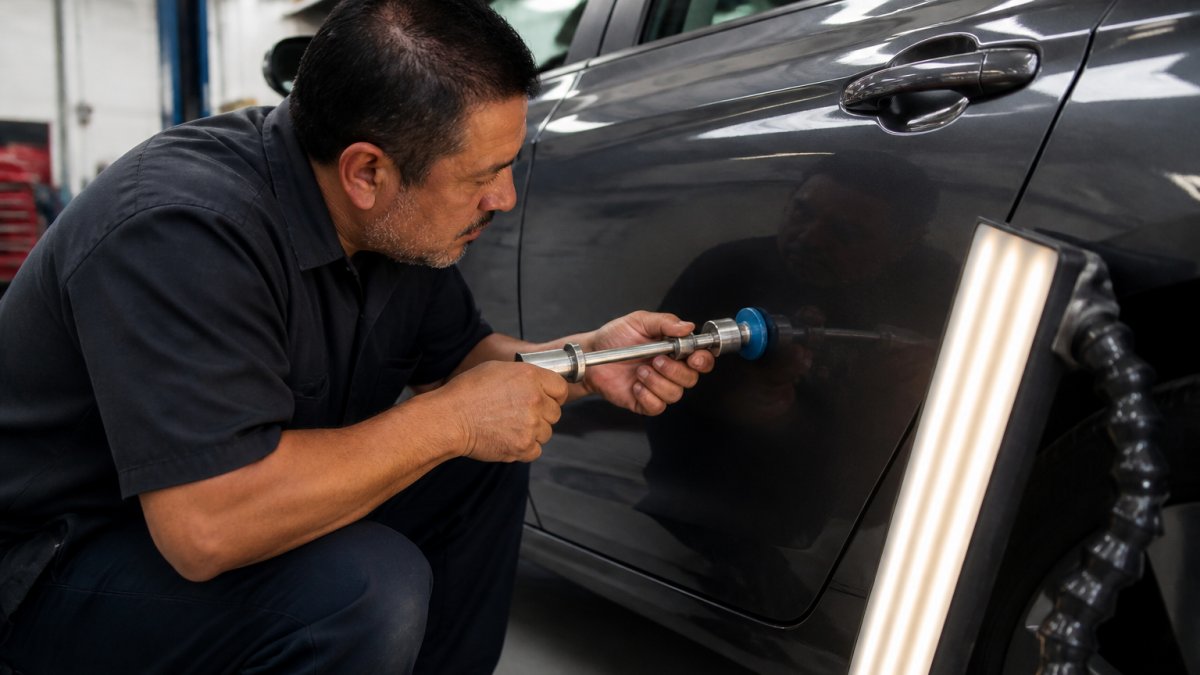
Close-up of a technician using a paintless dent removal tool on a car door with intact paint, bright garage lighting
Factor
Paintless Dent Removal
Collision Repair
Best for
Small dents, intact paint
Creased or paint-damaged panels
Factory finish
Preserved
Refinished after repair
Typical turnaround
Often same day
Multiple days
Paintless dent removal reshapes a dented panel from behind using rods and levers, without sanding, filling, or repainting, because modern sheet metal has memory.
Collision repair restores a vehicle through panel straightening, filler work, parts replacement, and refinishing, the correct path whenever paint, structure, or corrosion protection is compromised.
The deciding factor is not dent size but whether the paint has cracked and whether the metal has stretched past its elastic limit. A large, shallow dent with intact paint often responds to PDR; a small, sharp dent with a paint crack cannot.
Key Takeaway Judge the paint, not the dent. A quarter-sized ding with a cracked finish needs collision repair; a dinner-plate-sized shallow dent with intact paint is often a PDR candidate.
Paintless Dent Removal Cost and How Long Does Collision Repair Take
Paintless dent removal cost is driven by dent size, depth, location, and how easily a technician can reach behind the panel. A medium dent measuring three to four inches typically falls in the $280 to $425 range, with example repairs around $320 (Dent Time’s PDR pricing guide). Small door dings cost less; creased or aluminum panels cost more.
How long does collision repair take? Most minor collision repairs take two to five days, while structural or frame work can stretch to two weeks or longer. PDR is usually the faster option, with many dents repaired the same day (Boyd Autobody & Glass on PDR versus traditional repair).
Three variables move both numbers: access (a door skin is straightforward; a roof rail or brace takes longer), metal type (aluminum is harder to work and costs more), and paint condition (repainting adds drying and curing time that PDR avoids).
The cost gap is real, but not the whole story: a PDR repair keeps your factory paint, protecting resale value, while a repainted panel can be detected by a buyer or appraiser.
Pro Tip Ask any shop one question before you commit: “Will this repair keep my factory paint?” If the answer is yes, you are likely looking at PDR. If the answer is no, ask why the paint cannot be saved.
When Is Paintless Dent Repair Not Possible and Getting a Collision Repair Estimate
Paintless dent repair is not possible when the paint is cracked, chipped, or missing, when the metal is creased or stretched past its limit, or when the dent sits on a panel edge, seam, or structural brace. It also fails on previously repaired panels, where filler or old paint will not flex back into shape.
The practical test: run your fingernail across the dent. If it catches on a crack or sharp crease, PDR is off the table; if it glides over smooth, unbroken paint, PDR is worth a look.
A collision repair estimate accounts for everything PDR ignores: paint matching, panel replacement, corrosion protection, and structural alignment, which is why it takes longer and matters more.
Watch Out Do not let anyone attempt PDR on a dent with cracked paint. The metal will move, the paint will flake off in sheets, and you will pay for a repaint you could have planned for.
For drivers in Miramar, Pembroke Pines, and Hollywood weighing collision repair vs paintless dent removal, the safest move is a hands-on inspection. Victory Auto & Body Shop brings 40 years of experience, an advanced paint system for identical color matching, and full service for domestic and foreign vehicles, restoring your car to original factory specifications and protecting its resale value from estimate to keys-back.
Frequently Asked Questions
What is the difference between collision repair and paintless dent removal?
Collision repair restores structural and cosmetic damage using fillers, sanding, and repainting. Paintless dent removal massages dents from behind the panel while preserving the factory paint. PDR works for small dents with intact paint, while collision repair handles deeper damage, creased metal, or any damage where the paint is cracked or chipped.
How much does paintless dent removal cost compared with collision repair?
Paintless dent removal cost is typically lower because it skips paint materials and labor. Collision repair estimates vary widely based on damage severity, parts needed, and paint work, so request a written estimate from a shop before committing.
When is paintless dent repair not possible?
PDR is not possible when the paint is cracked, chipped, or peeling; when the dent is on a panel edge or crease; when the metal is stretched; or when damage affects structural components. In those cases, collision repair is the safer choice because it addresses both the metal and the finish.
Most drivers wait too long to get a dent looked at, and small damage turns into paint failure and rust. Whether your vehicle needs paintless dent removal or full collision repair, get an honest assessment before the problem grows. Victory Auto & Body Shop offers dealership-quality results with a personal atmosphere, high-quality parts for safety and appearance, and a repair process built around you. Book now and get your vehicle back to factory condition.