
- November 2, 2026
- By admin-dr
- In Blog, Paint
- Tags car paint blending, car paint code lookup, custom car touch-up paint, factory paint matching, factory paint matching for cars, how to match car paint without a paint code
- 57
- 0
Last Updated: October 20, 2026
Factory paint matching for cars starts with the paint code, the alphanumeric tag the manufacturer assigned to your vehicle’s original color.
Factory paint matching recreates a vehicle’s original OEM color using the manufacturer’s formula, then adjusts it for age, fading, and production variation. A code alone gets you close; a technician’s eye gets you exact.
Automotive paint is applied in layers: primer, a base coat carrying the color, then a clear coat.
The process runs in order: find the paint code, pull the OEM formula, mix a sample, spray a test panel, compare it to the car in daylight, adjust until the two agree, then blend into adjacent panels so no hard edge shows.
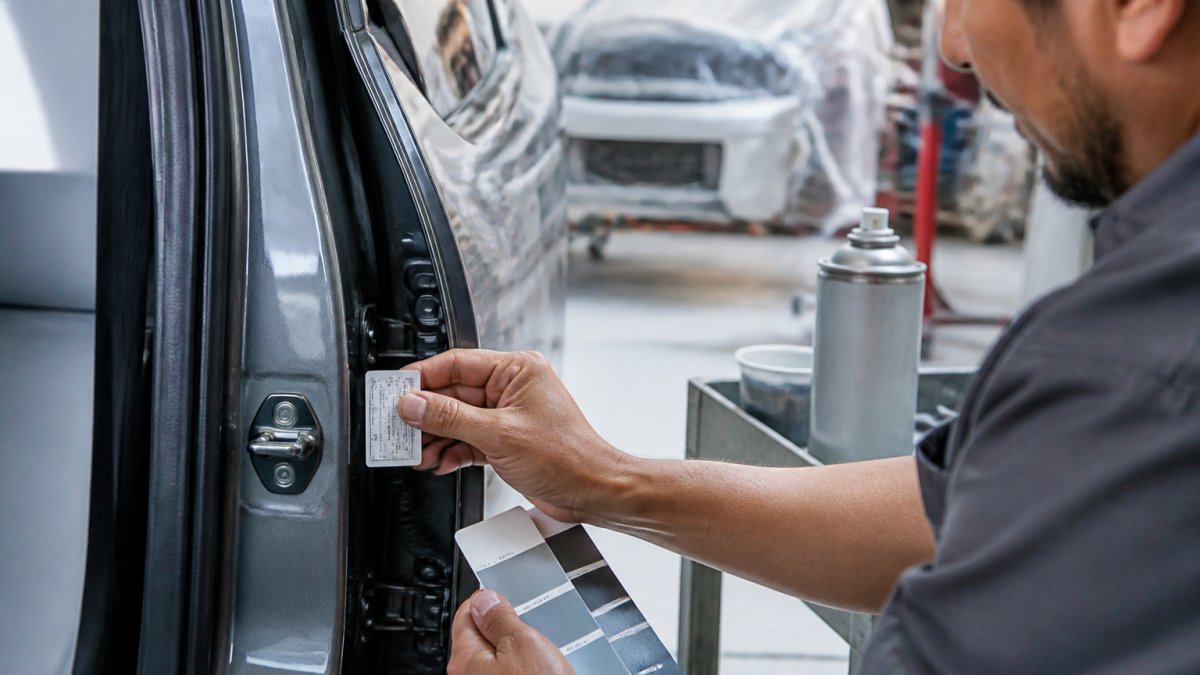
The paint code lives on a label: the driver’s side door jamb, under the hood on the firewall or a strut tower, in the trunk near the spare tire well, or on the vehicle identification plate at the base of the windshield.
Write the code down exactly, including any letters. One wrong character sends you to a completely different formula.
A car paint code lookup is only as good as the code you feed it. With the right characters, a paint supplier can cross-reference the manufacturer’s formula from digital databases. The harder question is what to do when the label is gone, stickers fade, peel, and disappear after a repair or repaint.
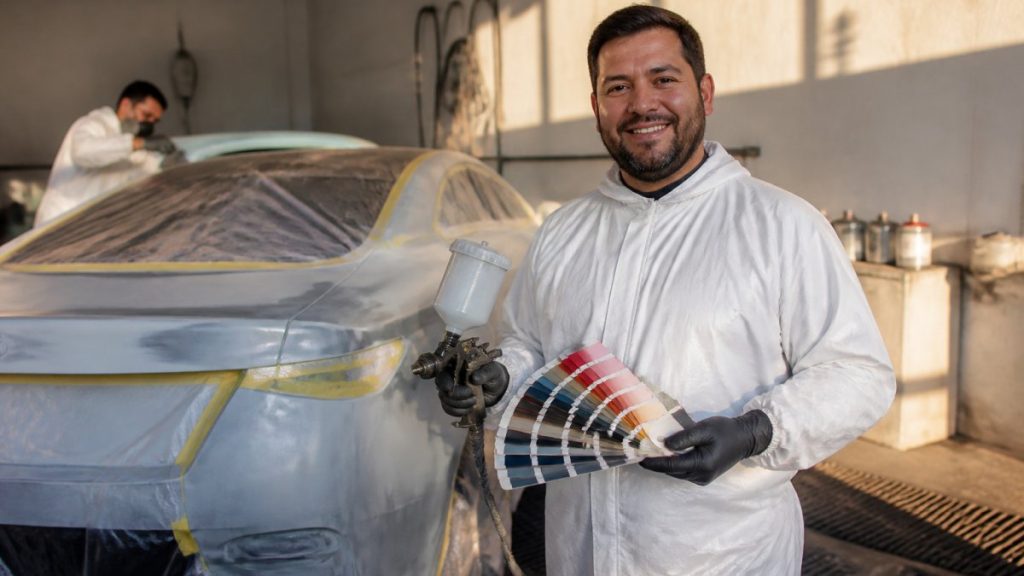
Without a code, a technician matches by eye and instrument. The most reliable method is a fan deck, physical color chips held against the panel until one disappears against the car, confirmed with a color sample sprayed on a test card.
| Method | Accuracy | Best For | Limitation |
|---|---|---|---|
| Paint code plus test spray | Highest | Most repairs | Needs a readable label |
| Fan deck plus test spray | High | Missing or damaged labels | Slower, relies on trained eye |
| Digital color camera | Good | A starting point | Still needs human adjustment |
A digital camera reads a panel and suggests a formula, but treat it as a first draft, cameras struggle with metallic and mica finishes, so a person still has to confirm the result.
The code is correct, the formula is correct, and the panel still comes out wrong. The reasons are consistent: paint aging (sun breaks down clear coat and shifts the base color), production variation (the same code varies between plants or batches), panel history (a previous repair may have used a non-OEM formula), and finish differences (metallic and mica flakes settle differently).
Faded paint is the single biggest reason a code-based match fails. A car that has spent years in strong sun shifts lighter or duller, especially on horizontal surfaces like the hood and roof, while vertical panels fade more slowly, so the same car can hold two versions of one color. A good technician inspects the whole vehicle and compares the repair area against several adjacent panels.
Car paint blending hides the repair. Even a near-perfect color match shows a hard edge if the new paint stops abruptly against the old, so blending feathers the new finish into surrounding panels until the eye reads one continuous color.
The workflow: clean and prep the repair area, apply primer and let it cure, spray the base coat building coverage gradually, blend past the repair onto adjacent panels, apply clear coat, then wet-sand and polish to match the surrounding finish.
Not every job needs a full respray. For a scratch, chip, or small scuff, custom car touch-up paint mixed to your code handles the repair without a booth, though it sits on top of the existing finish and will not blend like a sprayed panel. For small chips it is a reasonable fix; for anything larger than a coin, blending is the better path.
Two panels can carry the identical formula and still look different: clear coat gloss, surface texture, and light angle all change what your eye reports. That is why we evaluate every match under direct sun, shade, and indoor light, if the panel holds up under all three, the match is real.
Consider professional help when the damage spans multiple panels, the finish is metallic, mica, or a three-stage pearl, the car has faded unevenly, you need a lease return to pass inspection, or the repair sits on a visible surface like a hood or door.
Factory paint matching for cars rewards patience: pull the code, mix the formula, spray a test panel, and check it in daylight before you commit.
Not always exactly. Factory paint matching starts with the OEM color code, but the paint on your car has aged through sun exposure, and the factory itself may have produced slight color variation across model years and plants. A code-based formula gets you close, but a test spray and visual inspection against the actual panel are what confirm the match. Body shops often adjust the formula or blend into adjacent panels so the repair disappears into the existing finish.
Yes. Experienced shops account for faded paint by sampling the current color rather than relying only on the code. They may tint the formula, compare color chips in natural light, and blend the new paint across adjacent panels so any slight difference fades out gradually. This is why car paint blending matters on older vehicles: an exact code match on a sun-faded hood can look worse than a carefully blended panel.
Look at the repaired area in daylight, not under shop lighting, and view it from several angles. Metallic and mica finishes shift as you move, so a match that looks right head-on can look off from the side. Check the panel edges and any blend zones for a visible line. If you spot one, ask the shop to re-check the color formula and test spray before the clear coat fully cures.


